July 6, 2026
Russia Turned a Helicopter Pilot Into Cannon Fodder. Samuel Maina Kariuki Escaped Twice and Is Still Paying the Price.
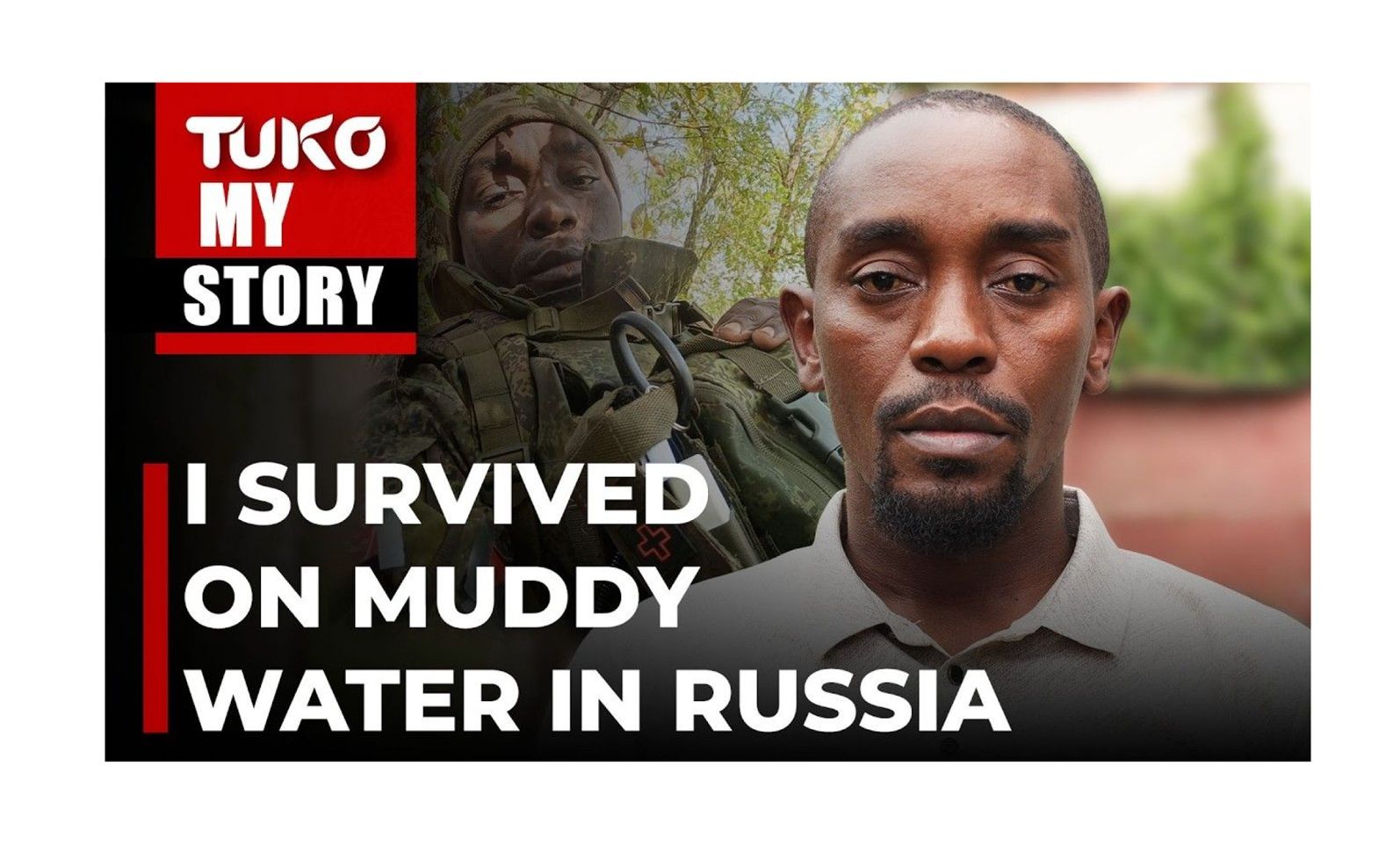
The man sharing this account is a former member of the Kenya Defence Forces named Samuel Maina Kariuki. He served in Somalia. He knows how to navigate by stars and by the position of the sun. He knows how to move through hostile territory without equipment. He knows what a battlefield looks like.
None of it helped him avoid getting scammed into joining Russia's army ranks.
He was trafficked into the Russian Armed Forces through an agent who promised a mall security job. He spent months on the front line in Donetsk Oblast. He hid behind a fallen tree for six days. He was caught trying to leave at Moscow's Domodedovo Airport, handcuffed, and held in a cell for three days with only chocolate and water, unable to leave to use a bathroom. Then he was sent back to a military camp. Then he escaped again - on foot, through a forest, past two armed checkpoints - and made it to the Kenyan Embassy in Moscow for the second time.
There is shrapnel in his neck that was never removed. There are three fragments in his right thigh that were never removed. He cannot afford the surgery.
Before Russia
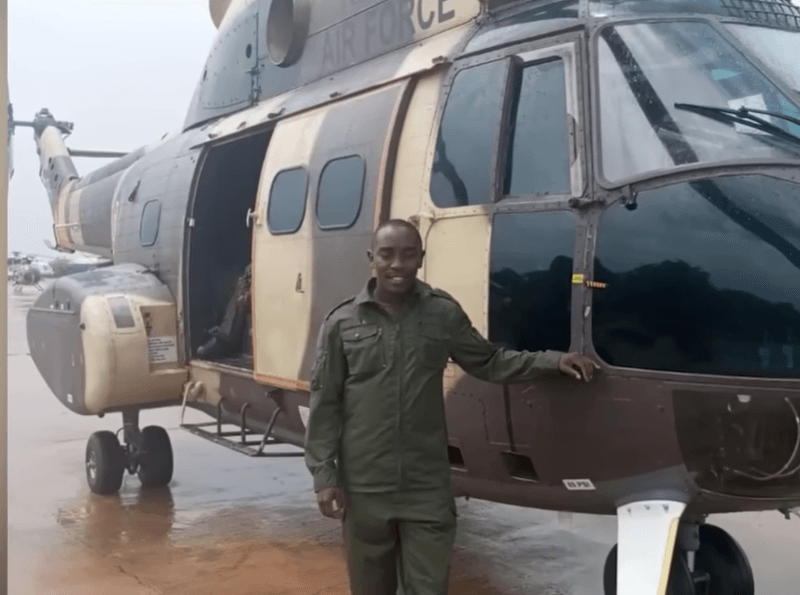
Samuel is not a typical victim of Russia's recruitment pipeline. He spent nearly eight years in the Kenya Air Force as a helicopter pilot - 186 flight hours across seven aircraft types. He is a graduate of a Kenyan military academy. He left the Air Force in 2022.
In 2023 he worked at an airport training new pilots. In July of that year he accepted a contract to fly in Somalia - legitimate aviation work. He spent fifteen months there, sending money home: building a proper house for his parents, covering school fees for younger family members. He was doing well.
When the Somalia contract ended, he was looking for the next thing. That is when the offer came.
The Recruitment
A recruiter approached him with a mall security position - the kind of contract African professionals regularly take in countries like Qatar. It looked entirely normal. He went to Nairobi, where the agency handled his documents. The contract he signed there matched exactly what had been described: security work, standard terms. He saw no reason to doubt it.
He flew St. Petersburg Pulkovo via Istanbul.
On arrival in Russia, the tone changed immediately. He was photographed and documented in detail - profiled, he says, rather than processed. He and the others were given new clothing: training suits. Then they were taken to a bank, where cards were waiting for them.
The paperwork at the bank was in Russian. They were not given time to translate it. What Samuel did not know - and would only discover later - was that the documents listed the Russian handler as his next of kin, and that the 2.5 million ruble signing bonus written into the contract was designated to be transferred not to Samuel, but to the man who had brought them there. When another recruit quietly suggested Samuel install the bank app to access his own money, the Russian handler caught him mid-process. He was physically struck and told not to touch the phone again. He complied.
After leaving the bank they were cut off from wifi entirely, preventing access to their accounts. The following day: a medical evaluation. Then they were brought to a building that looked like an ordinary office - but inside, Samuel noticed the insignia. Signs. Posters. It was a Russian Ministry of Defence office. They were made to sign document after document in Russian. He understood by then that something was wrong, but the process moved too fast to stop. That evening they were brought to military barracks. A Russian officer informed them that they had already signed contracts, that nothing could be done, and that they would be proceeding as soldiers. Samuel found two other former KDF men in the barracks. Together they confirmed what all three had concluded separately: they were being coerced into military service. The Russians did not issue uniforms at this stage - a deliberate choice, Samuel believes, to keep the recruits uncertain about what they were being prepared for. They were put on a train toward the Ukrainian border. A brief bootcamp. One day of weapons training. Then motorbikes to their regiment in Belgorod, where they were told a month of training awaited them. That was a lie. Everyone was already at the front.
What the Frontline Is
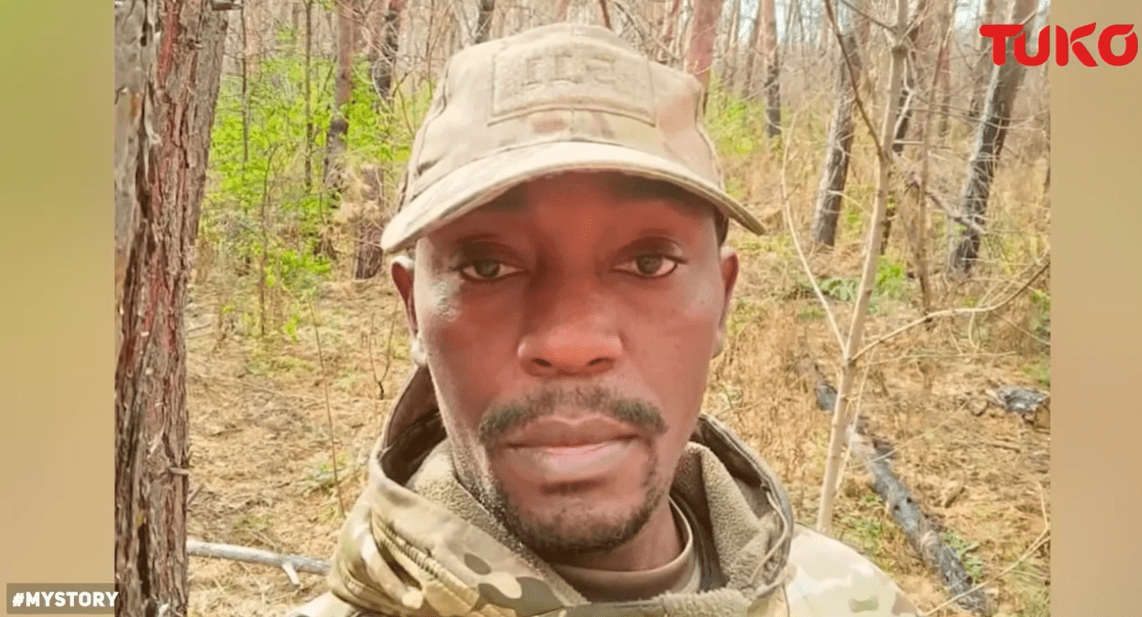
He has a precise answer to what fighting for Russia in Ukraine actually means, and it is not what most people imagine.
"You know in Kenya we're trained to fight against enemies who are carrying guns, tanks, maybe artillery. But on the Russian battlefield, we were not even fighting against the actual enemies - we were fighting against metals in the form of drones."
He describes three types of drones. The first surveys the battlefield, photographs positions, and transmits grid coordinates to tank operators who then fire. The second carries a large bomb and crashes directly into concentrations of troops. The third - the big one - flies at night, can carry up to twenty bombs, and has weight sensors: if you stand completely still in an open field it may not detect you, but the moment you move, it senses the motion and drops a grenade.
"The guy you're fighting against is quite far - like from here to Makongeni. A guy could be in Makongeni but he is fighting with you right here. The big drones can cover 200 kilometers. There is no drone that covers less than 10 kilometers. You will never come face to face with the actual enemy. The only human enemies you ever encounter are the ones already killed by drones from our side. This is a drone-to-drone war."
Your job, he explains, is simply to hold the ground that has already been taken. You sit in a trench. The drones find you or they don't.
"The bullets we were being given were actually supposed to help us end our own lives when we can't take it anymore. Because you can't shoot at those drones - they move faster than any human being can track. And the person operating them is 200 kilometers away."
He also says: you cannot walk five meters without stepping on a body.
150 Men. 6 Came Back.
Samuel's first major operation was the assault on a position near Kostiantynivka in Donetsk Oblast. His battalion numbered 150 men. They took the position easily - too easily. It was a Ukrainian trap. What followed was an onslaught of drones in numbers he had never seen. The battalion was destroyed. Of the 150 men who went in, six came back alive: two Kenyans and four Russians. Samuel survived because he found a large fallen tree and did not move.
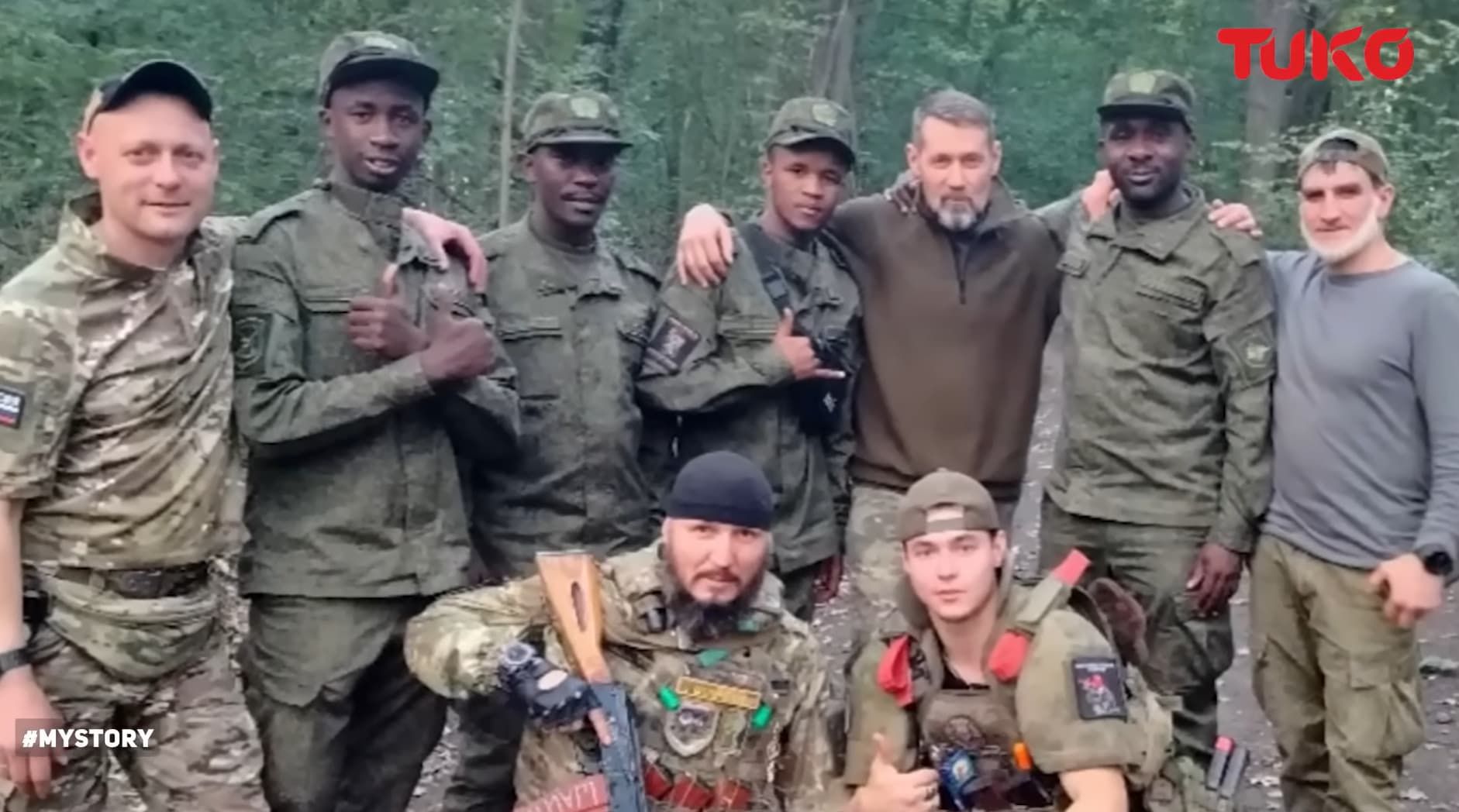
"I was rescued because I found a huge log and I laid behind it straight for six days. Trees there are very huge. So I went and laid next to that log. For six days."
A Russian survivor eventually found him. The man gave him bad water and two spoonfuls of canned fish - everything he had. Together they hid under antidrone blankets designed to defeat thermal detection. Samuel's weapon was in pieces.
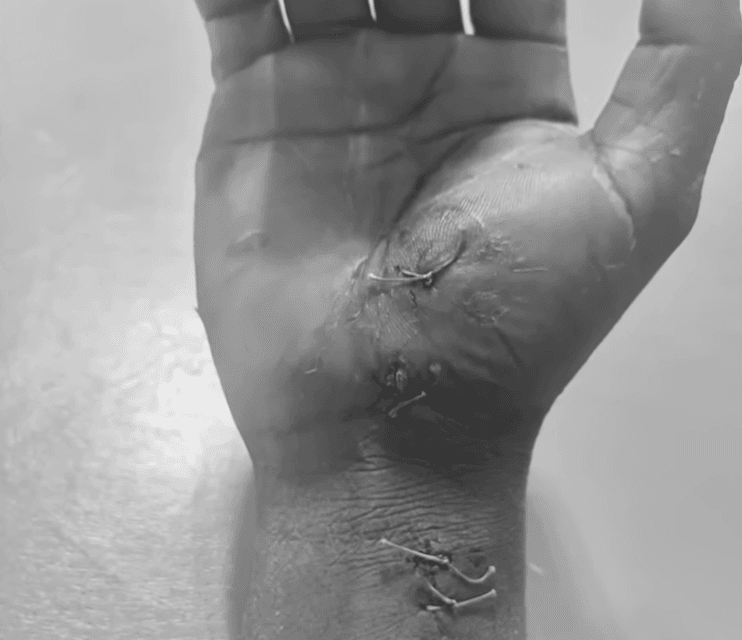
When they finally decided to move back toward their commander's position, walking through the tree lines, Samuel's companion was hit by a drone and killed. Samuel himself was caught in another strike, found himself under rubble, and was wounded in the hand. He eventually encountered a group of Russian soldiers. They were not interested in helping. After a confrontation, they brought him to a commander - who was visibly surprised to see him alive. The commander had assumed everyone was dead.
Then Samuel was told to walk to the nearest hospital. It was 45 kilometers away. He walked.
The Trench
He was treated at a hospital in Belgorod. The shrapnel in his hand was cleared - seven fragments. But after four days, despite his wounds being unhealed, they would not let him continue treatment. A new commander handed him a bag of food and told him to return to the front.
While out in that sector, Samuel ended up sharing a trench with two Russian soldiers: a man roughly his own age, and an 80-year-old who could not hear.
"A bomb could go off right there and he'd ask who was messing with the cups. He couldn't hear anything."
They boiled dirty water with a tea bag and shared it. Some days there was rice: two spoonfuls each. From August to December, he did not shower.
"I think from August I came to take a shower on 15 December, when I was in the hospital. People who washed me - they'd be laughing. They said: 'You're not clean, your body is removing oil.'"
The reason he had no infections: winter. The cold refrigerates everything. Bodies in the field do not decompose. There is no odor. There is just the cold. In that war, he says, if you see a man who has survived two weeks, that man is a star. The three of them survived 45 days. Samuel was deployed there on 15 October. One night the old man fell asleep and removed the antidrone wrap he wore to suppress his heat signature. A drone detected him. He was hit on the legs.
"He was gone. And the other guy's eye was hit."
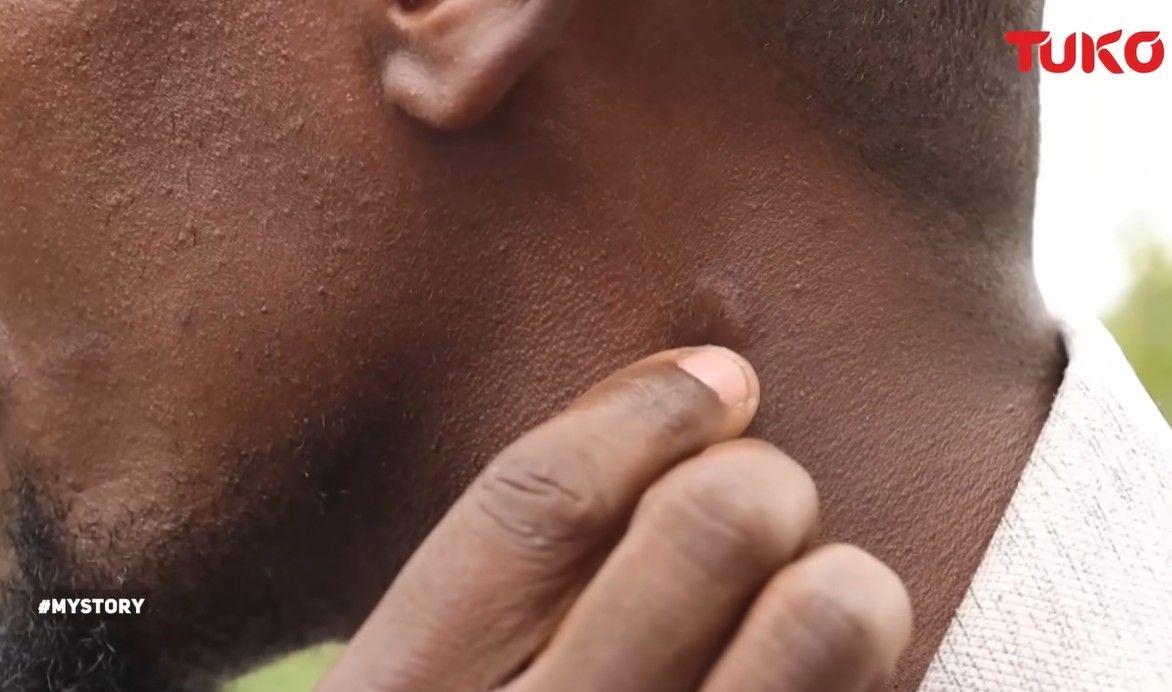
This is when the fragments entered Samuel's neck and thigh - injuries that remain with him today.
The Second Hospital
The morning after, mist came. Samuel told the third man he was not waiting for a command. He was going to find the commander himself. He stood up and walked.
"When there is mist, the drones can't fly - they can't locate anything. It was like God sent the mist so that I could come back home."
He used what the KDF had taught him: the position of the sun, the North Star, the direction of east.
"I knew that Ukraine was on the left side. So I knew that if I was going east, I was going back to Russia. The moment you make the mistake of going west, you head straight into enemy territory."
He found a familiar road and reached the commander - a different one this time, who was again astonished that he was still alive. Two men were sent to escort him further. When the mist cleared and drones appeared again, the escorts ran. Samuel continued alone.
"Whenever I remembered my little daughter, I would be encouraged to keep going."
First Escape - And the Airport Cage
He was evacuated to a hospital in Belgorod, treated for a week, and then transferred to a hospital in Pushkin, near St. Petersburg - the city where his journey into Russia had begun.
There he was fortunate. A doctor recommended he pursue a "grade 4" discharge - a medical commission from the army as unserviceable on health grounds. He was transferred to a civilian hospital. It was unguarded. On the third day, he walked past the gate, took a taxi, and went directly to the Kenyan Embassy in Moscow.
The embassy staff - he names Madam Rose, Madam Irene, and Ambassador Mathuki specifically - received him well. They processed an emergency travel document. He paid KES 120,000 (~$920) to reach Moscow, then KES 89,000 (~$685) for his flight ticket. He had approximately KES 289,000 (~$2,200) remaining in the bank account opened at the start of his deployment - the agent who had recruited him had since disappeared without draining it. He now had KES 30,000 (~$230) left.
He went to Domodedovo Airport. He had not deleted the contents of his phone. Security checked his phone and found his hospital documents. The records showed he was a soldier, not a tourist. He was handcuffed on the spot.
"I was placed in a civilian police holding. I watched the plane I was supposed to have boarded flying above us. I was put in a cage for three days straight like a dog. I'd only receive chocolate and water. I wasn't allowed to leave at all so I used to pee in a bottle."
After three days, the military police came for him. He was transferred back to a military regiment and sent to a position in the east of Ukraine. He was with two other Kenyans: Nicholas Keino, a former GSU officer, and a man named Kevin.
[Nicholas Keino from Kenya was found killed, according to the list of identified Africans killed in Russia's army, ed.]
He tried to bribe a doctor with KES 20,000 (~$154) to declare him unfit for combat. The doctor's actual advice was more useful: act completely stubborn. Smash things. There is nothing they can legally do to you. He took the advice literally and smashed a commander's phone on the ground. He was slapped once. For a month, they alternated between locking him in a cell, confiscating his phone, and making him cut firewood.
The Second Escape
Then came the moment.
The guard responsible for locking their quarters went to shower. He left in a hurry, towel over his shoulder. He forgot to lock the door.
"I told Nicholas: that is our God-given moment. We'd rather escape even if we'd still be arrested out there."
Nicholas went to make coffee as a pretext. Samuel was already out the door and into the forest. Nicholas followed immediately but they took different directions in the dark and lost each other in the trees.
He was alone again. No documents. No phone. Winter forest. Two armed military checkpoints between him and the nearest town.
He used the North Star to navigate. At the first checkpoint, soldiers fired at him. He crawled five hundred meters and slid into a ditch. They stopped shooting - they thought it was a wild animal. The second checkpoint did not see him at all.
He reached Shebekino. He found a group of young men drinking in a van, spoke to them in Russian - he had learned enough to manage - and offered to buy them alcohol if they let him into the car. They agreed. He called a woman who was in contact with his mother in Kenya. He told his mother he needed KES 500,000 (~$3,850). His mother began borrowing from everyone she knew.
She sent KES 100,000 (~$770) first. He bought the young men alcohol worth KES 20,000 (~$154). He arranged a taxi to Moscow - KES 150,000 (~$1,150), plus KES 20,000 (~$154) more because the driver noticed he had no documents and became nervous. The driver agreed to hide him in the boot at every police checkpoint along the route and return him to the front seat after being cleared. They drove all the way to Moscow.
At the embassy, Ambassador Mathuki greeted him.
"He called me the prodigal son."
This time he had flushed his phone and erased everything before going to the airport. The embassy booked him a flight from Vnukovo - Vnukovo to Turkey to Cairo to Nairobi. But when he arrived, the booking turned out to be separate tickets rather than a single itinerary, and the airline would not accept them. He had to buy a new ticket on the spot: KES 369,000 (~$2,840). His family kept contributing until they had the full amount.
Two seats remained on the flight when he paid. He checked in immediately.
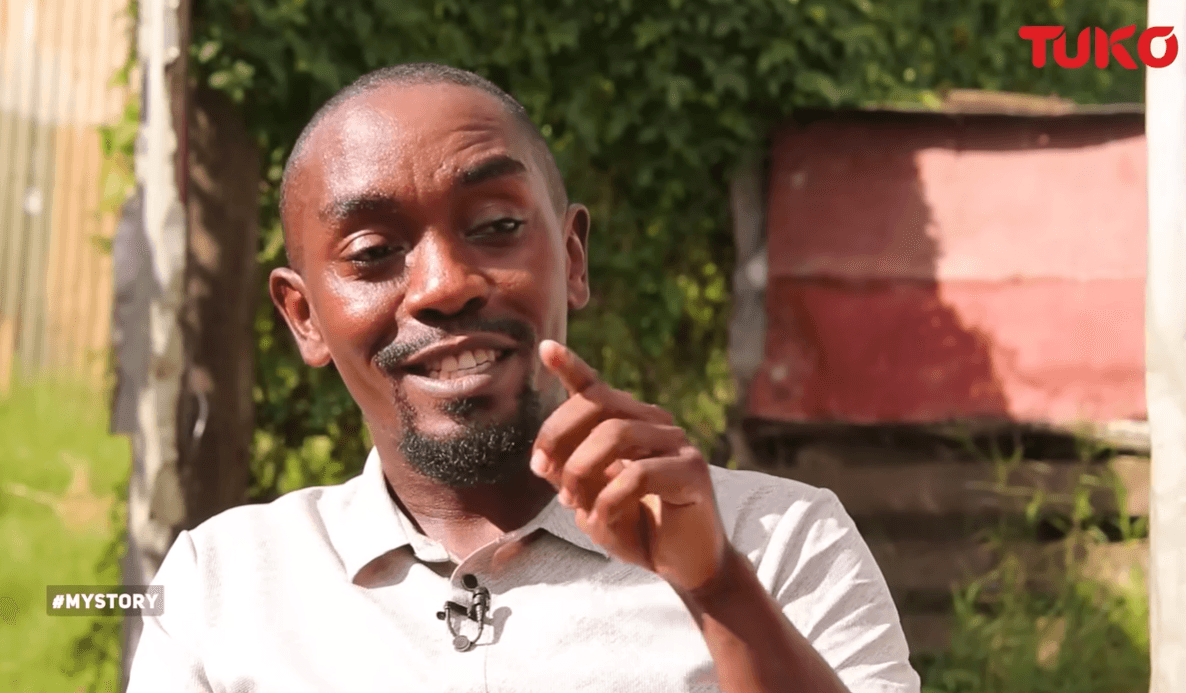
He landed at JKIA. He was home.
What Remains
Shrapnel in his neck: still there. Three fragments in his right thigh: still there. He cannot afford the surgery - his family is still KES 120,000 (~$920) in debt from everything it cost to bring him home. When he walks more than two kilometers, his leg goes numb.
He goes to therapy. The buzzing of a fly is enough to make him think the drones are coming.
"Even today?"
"Yes. But at least it's been a while since I returned, so at least I have gone to therapy for a while."
Before Russia, Samuel was a licensed helicopter pilot. He wants to fly again. But revoking a lapsed license and getting it re-certified is expensive - and with his family in debt and his body still carrying Russian shrapnel, it is not yet possible.
For Kenyans
Do not accept any job offers in Russia. Recent reports show that the practice of luring foreigners into the ranks of Russian army has become a systematic phenomenon across the globe. However if you took the gamble and found yourself deployed to the frontline - seek help immidiately. The Kenyan Embassy in Moscow can help. Samuel reached it twice - once after being caught and sent back, and once successfully.
If you or your relative signed or were coerced into signing a contract with the Russian Armed Forces and are looking for a way out - Ukraine also offers it. Read the details here.
See also: Kenya approves two international anti-mercenary treaties to stop Russian recruitment of its citizens
Source: